
Yukon Landlord Compliance
Everything you're responsible for as a landlord in Yukon
Rent control, just-cause eviction, deposits, entry, repairs and recordkeeping, written for people who own or manage a few units, checked against the official sources, and kept current when the rules move.
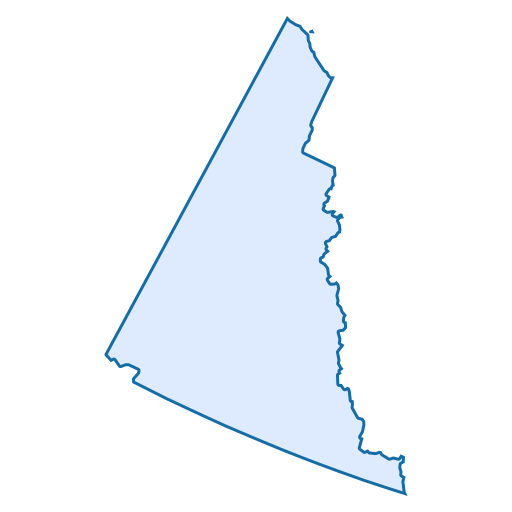
Jurisdiction
key details
Rent cap · Detail
Annual rent index (2-year avg Whitehorse CPI) caps increases for existing tenants: 2.6% for increases effective May 15, 2026–May 14, 2027. Above-index increases up to 3%/yr for 3 yrs allowed for extraordinary costs. Government has announced a phase-out.
Deposit cap · Detail
Security deposit up to 1 month's rent; a separate pet damage deposit up to half of 1 month's rent is permitted under the new Act.
Rent increase notice · Detail
Landlord must give at least 3 months' notice on the approved form; no increase in the first 12 months and only once per 12 months thereafter, within the rent index.
City rules · Detail
Rent index and tenancy rules are set by the territorial Act and Regulation and administered by the Residential Tenancies Office; municipalities have no rent-setting power.
Just cause · Detail
No-cause evictions eliminated; landlord may end a tenancy only on listed grounds (nonpayment, repeated late payment, damage, disturbance, landlord/purchaser/family use with 3 months' notice, major renovation, demolition/conversion, etc.).
Return deadline · Detail
Refund-or-claim: within 15 days of the later of the tenancy end date or receipt of the tenant's written forwarding address/e-transfer details, landlord must repay the deposit or apply to the Residential Tenancies Office to retain it.
Nonpayment notice · Detail
Landlord first gives written notice that rent is unpaid; if still unpaid 5 days later, landlord may serve a 14-day notice to end tenancy. Tenant has 7 days after receipt to pay (voiding the notice) or apply for dispute resolution.
What are you trying to do?
Start from the task. Each route gathers the guides, checklists and forms that apply to it in Yukon.
Essential local guides
If you're new to owning here, these five cover most of what will come up in your first year.
View All GuidesYukon Above-Index Rent Increases and the Ban on Algorithm Rent-Setting
A Whitehorse landlord who has just replaced a building's heating system finds that the rent index of 2.6% will not cover the bill. The Residential Tenancies Act offers a route for that: an application for an above-index increase of up to 3% on top of the index, for up to three years. It also closes a route some landlords may be tempted by, which is setting rent with pricing software.
Guide
Yukon Pet Damage Deposits: What Landlords Can Collect and When Deposits Must Be Returned
A Yukon tenant adopts a dog in the second year of a tenancy and the landlord, who already allowed pets, wants a pet deposit. Under the Residential Tenancies Act in force since September 1, 2025, that request may not be allowed. A pet damage deposit is permitted, up to half a month's rent, but only once per tenancy and not where the landlord has already permitted the tenant to have pets.
Guide
Yukon's Two-Step Process for Unpaid Rent: The 5-Day Notice and the 14-Day Termination Notice
A Yukon tenant misses the first of the month. Under the Residential Tenancies Act, the landlord cannot go straight to a termination notice. There is a 5-day notice first, then a 14-day notice only if the rent is still unpaid, and a tenant who pays the arrears in time can stop the process.
Guide
Yukon No-Cause Evictions Ended Under the New Residential Tenancies Act: Grounds, Notice and Compensation
A Whitehorse landlord who wants a unit back used to be able to ask whether a cause was needed at all. Under the Residential Tenancies Act that took effect on September 1, 2025, it is. Tenancies end only on listed grounds, each with its own notice period, and some carry compensation the landlord has to pay.
Guide
Yukon 2026 Rent Index Is 2.6%: What Landlords Can Charge From May 15, 2026
A Whitehorse landlord planning a rent increase for the new rent year has to work backwards from May 15. Notice has to go out at least three months before that date, and the most the landlord can ask for on a $1,500 unit is $39. That is the effect of the 2026 rent index, set at 2.6%, which the Yukon government has described as the last year the index applies in its current form.
Guide
Recent changes
Only substantive changes, not copy edits.
15 May 2026
2026 rent index set at 2.6%
The rent index for increases from May 15, 2026 through May 14, 2027 is 2.6%.
1 Sept 2025
New Residential Tenancies Act framework begins
Yukon’s updated residential-tenancies framework and related forms took effect September 1, 2025.
Full Yukon collection
Filter by what you're doing or by the kind of resource you need.
| Resource | Type | Task | Reviewed |
|---|---|---|---|
Yukon Above-Index Rent Increases and the Ban on Algorithm Rent-Setting A Whitehorse landlord who has just replaced a building's heating system finds that the rent index of 2.6% will not cover the bill. The Residential Tenancies Act offers a route for that: an application for an above-index increase of up to 3% on top of the index, for up to three years. It also closes a route some landlords may be tempted by, which is setting rent with pricing software. | Guides | Raise the rent | Oct 6, 2026 |
Yukon Pet Damage Deposits: What Landlords Can Collect and When Deposits Must Be Returned A Yukon tenant adopts a dog in the second year of a tenancy and the landlord, who already allowed pets, wants a pet deposit. Under the Residential Tenancies Act in force since September 1, 2025, that request may not be allowed. A pet damage deposit is permitted, up to half a month's rent, but only once per tenancy and not where the landlord has already permitted the tenant to have pets. | Guides | Return a deposit | Oct 6, 2026 |
Yukon's Two-Step Process for Unpaid Rent: The 5-Day Notice and the 14-Day Termination Notice A Yukon tenant misses the first of the month. Under the Residential Tenancies Act, the landlord cannot go straight to a termination notice. There is a 5-day notice first, then a 14-day notice only if the rent is still unpaid, and a tenant who pays the arrears in time can stop the process. | Guides | End a tenancy | Oct 6, 2026 |
Yukon No-Cause Evictions Ended Under the New Residential Tenancies Act: Grounds, Notice and Compensation A Whitehorse landlord who wants a unit back used to be able to ask whether a cause was needed at all. Under the Residential Tenancies Act that took effect on September 1, 2025, it is. Tenancies end only on listed grounds, each with its own notice period, and some carry compensation the landlord has to pay. | Guides | End a tenancy | Oct 6, 2026 |
Yukon 2026 Rent Index Is 2.6%: What Landlords Can Charge From May 15, 2026 A Whitehorse landlord planning a rent increase for the new rent year has to work backwards from May 15. Notice has to go out at least three months before that date, and the most the landlord can ask for on a $1,500 unit is $39. That is the effect of the 2026 rent index, set at 2.6%, which the Yukon government has described as the last year the index applies in its current form. | Guides | Raise the rent | Oct 6, 2026 |
Page 1 of 1 · 5 resources
From reading to managing
Keep these responsibilities handled, not just understood
Add a San Francisco property and Platuni tracks the deadlines, keeps the records you'll need, and tells you when a rule you rely on changes.
What you read about
Rent increase dates and notice
In Platuni
Obligation tracking with reminders
What you read about
Move-in and move-out photos
In Platuni
Records kept per unit, per tenancy
What you read about
Repair requests and responses
In Platuni
Maintenance log with timestamps
What you read about
Everything a hearing could ask for
In Platuni
One-click audit package